
Food choices influence the risk of some cancers, but there is no single cancer-proof diet. The strongest evidence concerns whole grains and fiber, processed meat, alcohol and long-term dietary patterns.
Does a Clear Scan Mean All the Cancer Is Gone?
CancerSnoop Claim Check
Does a Clear Scan Mean All the Cancer Is Gone?
Verdict · MISLEADING
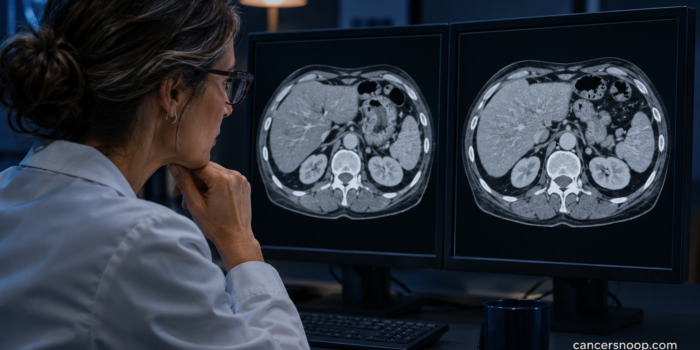
A clear scan after cancer can mean there is no disease visible on that examination. That can be good news while leaving uncertainty about microscopic disease and the need for follow-up.
Claim Statement
A clear CT, MRI or PET scan proves every cancer cell is gone and further monitoring is unnecessary.
Claim Origin
In everyday language, “clear” sounds final. In a report, “no evidence of disease” depends on the examination, the findings being followed and the timing.
What does a clear scan after cancer actually say?
Start with the report’s impression, the short section where the radiologist summarizes the most important findings. Check which body regions were examined and what the scan was asked to look for. No suspicious findings in the chest and no evidence of recurrence at the surgical site are different observations. A report may also describe stable scars or other changes without calling them active cancer. Ask the team to interpret the wording against the reason the scan was ordered.
Complete response and the limits of imaging
A complete response is a term used to describe how all measurable evidence of disease responds under defined criteria. In solid-tumor studies, RECIST is one system researchers use to make response assessments comparable. In everyday care the oncologist may also consider pathology, symptoms and other tests. The NCI notes that cancer can still be present after all signs and symptoms disappear in complete remission. [1] [2]
A scan detects patterns at the level of tissue. Small clusters of cells can be below the resolution of the scan. Differences in contrast, motion or the timing of an examination can also affect what stands out. In some situations a different scan is better suited to a particular location or question. These limits are reasons to interpret imaging in context. They do not tell you that hidden cancer is present in any one person.
Why timing and comparison matter
A clear report soon after treatment answers what could be seen at that moment. The meaning can evolve as your team compares examinations over time. If a previous lesion has disappeared, ask whether the radiologist had the prior images and how they assessed the original site. If your scan is described as stable, ask what stayed stable. In one report it might refer to expected changes after treatment. In another it might refer to known disease that has not grown.
How follow-up uses the result
A surveillance plan can include visits, scans or other tests, depending on the cancer and the treatment already given. There are different schedules for different clinical situations. The NCI describes follow-up as a way to check for recurrence and other problems after treatment. [3] Very sensitive tests for residual disease have defined roles in some cancers. Their usefulness and how doctors should act on the result depend on the setting. [4]
Ask your oncologist what the scan rules out with reasonable confidence, which area remains difficult to assess, and when the next review is planned. If the team used a response term, ask whether it changes the current treatment plan or simply records how the last scan looked. That gives you an answer you can use when reading the next report.
How to compare two reports
Bring both reports and ask whether they describe the same body regions and were made with comparable techniques. A small difference in wording can reflect a different radiologist or a different clinical question. What matters is whether the team sees a meaningful change in a specific finding and whether that change calls for a different plan.
If you had a clear scan after cancer treatment, ask for the exact wording your team uses to describe your current disease status.
Sources and References
Continue Exploring