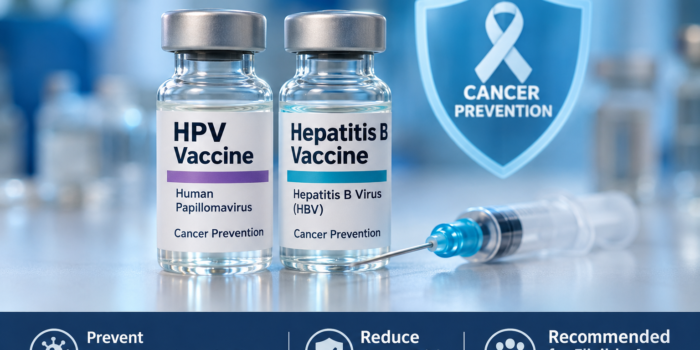
Food choices influence the risk of some cancers, but there is no single cancer-proof diet. The strongest evidence concerns whole grains and fiber, processed meat, alcohol and long-term dietary patterns.
Overweight and Cancer Risk: What Does Research Show?
CancerSnoop · Cancer Prevention
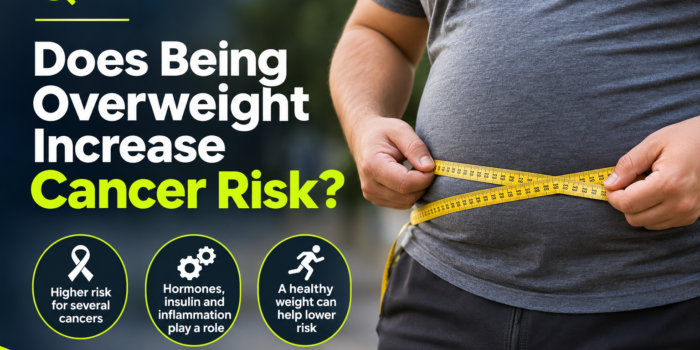
Does Being Overweight Increase Cancer Risk?
Excess body fat is linked to several cancers.
Here’s what science knows about the risks,
biological mechanisms, and weight loss.
The short answer
Yes. Excess body fat increases
the risk of at least 13 cancer types.
Maintaining a healthy weight is a supported
prevention strategy, but losing weight does
not guarantee protection against cancer.
The relationship between
overweight and cancer risk
is supported by decades of research.
Body fat is biologically active tissue:
it influences hormones, inflammation,
and metabolic processes that may contribute
to cancer development.
However, weight is only one risk factor.
Genetics, age, infections, smoking, and other
exposures also matter. Many people with
obesity never develop cancer, while people
with a healthy BMI can still be diagnosed.
Which cancers are linked to excess body fat?
The National Cancer Institute identifies
13 cancer types associated with obesity.
Some of the strongest associations involve
endometrial, colorectal, kidney, and
postmenopausal breast cancer.
| Cancer type | What research shows |
|---|---|
| Endometrial |
Strong association; hormonal changes, particularly estrogen exposure, play an important role. |
| Colorectal |
Greater body fatness is associated with increased risk. |
| Breast (after menopause) |
Excess body fat increases risk; findings differ before menopause. |
| Kidney |
Consistent evidence links obesity with increased risk. |
| Other cancers |
Includes pancreatic, liver, gallbladder and esophageal adenocarcinoma, among others. |
How can body fat influence cancer risk?
Excess body fat can affect several biological
pathways. Researchers believe these processes
may contribute to cancer development in
susceptible tissues.
Excess body fat
↓
Hormonal changes
Insulin signaling
Chronic inflammation
Metabolic changes
↓
May increase the risk of certain cancers
For example, fatty tissue contributes to
estrogen production after menopause.
Higher estrogen exposure can influence
endometrial and postmenopausal breast
cancer risk.
Insulin resistance and persistent low-grade
inflammation may also affect cell growth.
These mechanisms help explain the association,
but no single hormone or inflammatory test
predicts whether someone will develop cancer.
Does losing weight reduce cancer risk?
This requires an important distinction.
Evidence that excess body fat increases
cancer risk is stronger than direct evidence
that intentional weight loss prevents
every obesity-associated cancer.
A 2022 observational study published in
JAMA followed adults with obesity
who underwent bariatric surgery and matched
adults receiving nonsurgical care.
Over 10 years, obesity-associated cancer
occurred in approximately
2.9% versus 4.9%
of the respective groups.
What this means:
The findings support a potential benefit
of substantial weight loss, but the study
was observational. It does not prove that
every weight-loss method produces the same
reduction in cancer risk.
What does BMI tell us?
Body mass index (BMI) compares weight with
height. In adults, a BMI of 25–29.9 is
conventionally classified as overweight,
while 30 or above is classified as obesity.
BMI is useful for population research,
but it cannot distinguish muscle from fat
or fully describe abdominal fat distribution.
Waist circumference and metabolic health
may provide additional context.
What can you do to reduce risk?
Cancer-prevention organizations recommend
maintaining a healthy weight and avoiding
gradual weight gain throughout adulthood.
Sustainable habits matter more than
restrictive crash diets.
| Action | Practical approach |
|---|---|
| Stay active |
Build regular walking or other enjoyable physical activity into your routine. |
| Eat more fiber |
Choose whole grains, beans, vegetables and fruit regularly. |
| Limit sugary drinks |
Choose water or unsweetened beverages more often. |
| Choose sustainable habits |
Focus on changes you can maintain long term. |
These steps can improve overall health
even when weight changes slowly.
People with medical conditions or
weight-related treatment needs may
benefit from individualized advice.
Frequently asked questions
Does a normal BMI mean I cannot get cancer?
No. Cancer can develop at any body weight.
BMI is only one component of overall risk.
Does losing 5% of body weight prevent cancer?
No specific percentage guarantees
cancer prevention. Modest weight loss
may improve metabolic health, but
cancer-risk benefits vary.
Should someone undergoing cancer treatment lose weight?
Not without individualized medical advice.
During treatment, maintaining adequate
nutrition, muscle and strength may be
more important than weight reduction.
SUPPORTED
CancerSnoop Bottom Line
Excess body fat increases the risk
of several cancers.
Maintaining a healthy weight is an
evidence-based prevention recommendation.
Research on intentional weight loss is
encouraging, but its cancer-prevention
benefits are not equally established
for every cancer or weight-loss method.
Sources and further reading
Continue Exploring