OS and PFS answer different questions. Learn what cancer study results actually measure, why better PFS does not automatically mean longer life, and why median survival is not a personal deadline.
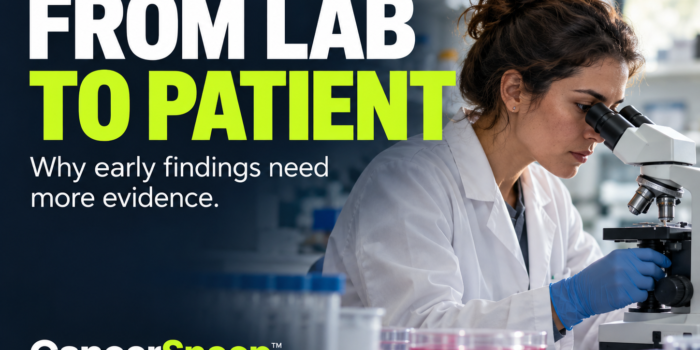
Preclinical Cancer Research: From Lab to Patient
CancerSnoop Research Explained
From Lab to Patient: Why Killing Cancer Cells Is Only the Beginning
A laboratory discovery can be an important step toward better treatment. Understanding what that step establishes helps us recognise real progress without promising more than the evidence shows.
Preclinical cancer research investigates cancer biology and potential treatments before they are tested in people. It can reveal a weakness in cancer cells, identify a useful drug candidate or raise an important safety concern.
However, showing that something damages cancer cells in an experiment does not establish that it will safely help a person with cancer.
The Core Question: What Does Preclinical Cancer Research Establish?
SUPPORTED
Laboratory activity alone does not establish clinical benefit.
Evidence Strength: Strong
This assessment applies to the distinction between experimental findings and evidence of benefit in patients. It is not a verdict on any particular experimental treatment.
Safety Level: Caution
The Short Answer
Understanding the Evidence
A useful discovery answers a specific question.
A cell experiment might show that a substance affects cell survival under particular conditions. A clinical study must investigate what happens when an intervention is given to people.
Those questions are connected, but their answers are not interchangeable.
What Do “In Vitro” and “In Vivo” Mean?
In vitro describes experiments performed outside a living organism, such as work with cells in a laboratory dish.
In vivo describes research within a living organism. In preclinical drug development, this may include animal models.
These approaches let researchers investigate mechanisms, dosing and potential toxicity before deciding whether a candidate should enter human testing. The FDA describes this as part of the preclinical development process. [1]
What Research Can Support
A reason to investigate further.
A reproducible finding can help researchers decide which biological targets or treatment candidates deserve additional testing.
What Remains Unproven
Benefit for a patient.
A laboratory result does not, by itself, establish a useful human dose, acceptable side effects or improved patient outcomes.
Why Is Killing Cancer Cells Only the Beginning?
Consider an illustrative experiment: a candidate substance reduces the number of surviving cancer cells in a dish.
Before treating that as a useful therapy, researchers still need to ask:
- Does the result occur again when the experiment is repeated?
- Does it occur in other relevant cancer models?
- What happens to non-cancerous cells?
- Can the substance reach the tumour at an effective exposure?
- Can that exposure be achieved without unacceptable harm?
- Does treatment eventually improve outcomes that matter to patients?
The original observation may be entirely real while these questions remain unanswered.
The Missing Step
An experimental concentration is not a prescription.
The amount placed directly onto cells in an experiment cannot simply be converted into a supplement dose or a treatment recommendation.
How an intervention is delivered and how the body handles it are part of the evidence that must be investigated.
Are Human Cancer Cells the Same as a Human Study?
No. The origin of the cells and the setting of the experiment are different things.
Cells originally obtained from a human tumour may be grown and studied in a laboratory. That makes them human-derived research material, but the experiment is still laboratory research.
A statement such as “tested on human cancer cells” should therefore not be read as “shown to work in patients.”
Can Better Models Help Close the Gap?
Yes. Scientists are developing models that capture more features of patient tumours.
One approach uses organoids: three-dimensional cell cultures that reproduce selected features of the tissue from which they were developed.
A study published in Nature in August 2026 described a biobank of 256 patient-derived tumour organoids across five cancer types. Researchers used genetic screening in 162 organoid models to investigate genes that cancer cells depend on. [2]
A Recent Research Advance
Better models can reveal better questions.
The organoid study provides a resource for investigating cancer vulnerabilities. It does not establish that a newly identified target can already be treated safely or successfully in patients.
Even a model developed from a patient’s tumour remains a model. Results need to be interpreted according to what the experiment measured.
What Evidence Comes Next?
When a treatment candidate has sufficient supporting evidence, researchers may investigate it in a clinical trial.
Human treatment trials address questions such as dosing, tolerability, treatment activity and comparisons with existing care. Eligibility criteria also determine which patients can participate. [3]
Moving into a clinical trial is progress. It is also an acknowledgement that important questions still need answers.
How Can You Read an Early Research Headline?
A Practical Reading Check
Look for the setting, the measurement and the next step.
- Setting: Were researchers studying cells, animals or people?
- Measurement: Did they measure cell activity, tumour changes, symptoms or survival?
- Comparison: What was the finding compared with?
- Limitations: Which questions could this experiment not answer?
- Next step: Is further laboratory work needed, or is human testing underway?
What Could Be Unsafe?
Potential Harm
Do not turn a laboratory headline into self-treatment.
Using an experimental substance, changing a medicine dose or replacing recommended cancer care on the basis of cell research can expose someone to harm without an established benefit.
If a finding interests you, bring the actual study to your oncology team and ask whether there is relevant human evidence or an appropriate clinical trial.
Related CancerSnoop Articles
CancerSnoop Bottom Line
CancerSnoop Bottom Line
Early findings can create real possibilities. Further evidence shows which possibilities help people.
Preclinical cancer research is essential to progress. Its value comes from what it discovers and what it helps researchers test next.
A result can be scientifically important without yet being a treatment option.
Scientific Sources
1. Step 2: Preclinical Research
U.S. Food and Drug Administration.
Official explanation of preclinical testing, dosing and toxicity assessment.
Read FDA information →2. A tumour-derived organoid biobank maps cancer gene dependencies
Herranz-Ors C, Bhosle SG, Beck AE, et al. Nature. Published online August 5, 2026.
DOI: 10.1038/s41586-026-10830-y. PMID: 42557320.
View original research →3. How Do Clinical Trials Work?
National Cancer Institute. Updated November 8, 2024.
Patient information explaining trial phases, eligibility and treatment comparisons.
Read NCI information →Questions for Your Doctor
- Was this finding made in cells, animals or patients?
- Has the approach been tested in people with my cancer type?
- What is known about dosing, benefits and harms?
- Is there a relevant registered clinical trial?
- Does this finding have any practical relevance to my current care?
CancerSnoop Note: Sources checked October 22, 2026. This educational overview is not a systematic review or an individual treatment recommendation. It does not replace advice from your cancer care team.
Continue Exploring