
Food choices influence the risk of some cancers, but there is no single cancer-proof diet. The strongest evidence concerns whole grains and fiber, processed meat, alcohol and long-term dietary patterns.
Can a Biopsy Spread Cancer?
CancerSnoop Claim Check
Can a Biopsy Spread Cancer?
Verdict · MISLEADING
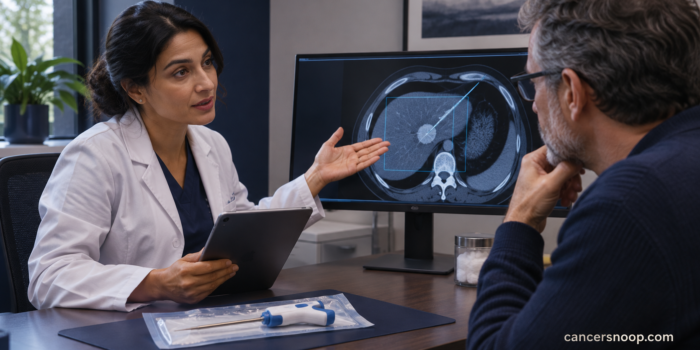
Can a biopsy spread cancer? It is extremely rare for a biopsy to spread cancer. In some settings, cells can implant along a needle path. The type of tumor, biopsy route and reason for sampling matter.
Claim Statement
A needle biopsy routinely spreads cancer or makes it metastasize, so it is safer to refuse tissue sampling.
Claim Origin
The claim takes a documented complication called needle-track seeding and applies it to every biopsy. It also conflates a cancer discovered after biopsy with a cancer caused to spread by biopsy.
When can a biopsy spread cancer along the needle path?
When a needle passes into an abnormal area, cells can occasionally be left along the path. For this to become a clinically relevant complication, the cells have to survive and form a detectable deposit. That local event is called seeding. Metastasis is a broader process in which cancer reaches a different part of the body, for example through the blood or lymphatic system. The American Cancer Society and the National Cancer Institute describe biopsy-associated spread as very rare. [1] [2]
What human studies can tell us
A 2024 meta-analysis looked at seeding after biopsy of liver lesions, with or without ablation during the same procedure. It examined a specific group of procedures. Liver lesions can be primary liver cancers or tumors that started elsewhere, and the studies did not all use the same technique or follow-up. The review provides evidence that seeding can occur in that setting. It cannot give an exact personal risk for a lung, breast or other biopsy. [3]
The study question also matters. Finding a deposit along a documented needle route is different from finding a new distant lesion on the first full set of scans. A later scan may cover a larger part of the body or show a lesion that was already there but too small to see. A sequence of events alone cannot distinguish those explanations.
What the sample can change
A tissue sample lets a pathologist examine cells and their surroundings. Two findings can look alike on a scan while representing different diseases, and treatment can depend on where the abnormal cells originated. For some cancers, the team also tests tissue for markers that help identify treatment options. Ask what decision the result could change and whether tissue already collected from another procedure could answer that question.
When access is technically difficult, the specialist may weigh a different sampling route, an alternate site, or whether another test can answer enough of the question. An oncology team considering surgery may want the biopsy route planned together with the surgical team. This depends on the suspected tumor and the local anatomy.
Questions before the appointment
Ask who selected the target and how imaging will be used to guide the needle. Ask whether seeding is a meaningful concern for your exact procedure and which other risks are more relevant. If you are worried about something you read, show the team the example and ask whether it involved the same cancer and technique. Before leaving, find out when the result will be available and whom to call if the report is inconclusive.
If the first biopsy does not answer the question
An inconclusive result can mean the sample did not contain enough material or that it did not capture the part of the abnormality needed for the diagnosis. Ask whether the tissue already collected can be examined again and whether the result agrees with the scan. The next decision depends on why the result was inconclusive and how much the diagnosis would change treatment.
When the question “can a biopsy spread cancer?” comes up, ask for the risks and benefits of the specific procedure being offered.
Sources and References
Continue Exploring