Food choices influence the risk of some cancers, but there is no single cancer-proof diet. The strongest evidence concerns whole grains and fiber, processed meat, alcohol and long-term dietary patterns.
Can a Glucose Monitor Tell You Which Foods Feed Cancer?
CancerSnoop Claim Check
Can a Glucose Monitor Tell You Which Foods Feed Cancer?
Verdict · FALSE
Can a glucose monitor tell you which foods feed cancer? It estimates glucose from fluid under the skin. It cannot tell you how much glucose a tumor uses or whether the tumor is growing.
Claim Statement
A wearable glucose monitor can tell a person with cancer which specific foods feed their tumor.
Claim Origin
Some posts combine a real CGM reading after a meal with a general fact that cancer cells can use glucose. The connection between the two observations is assumed.
What can a glucose monitor tell you after a meal?
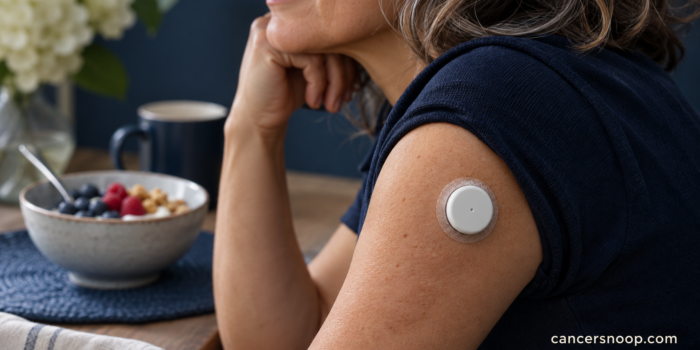
A continuous glucose monitor has a small sensor that sits under the skin. It measures glucose in the fluid between cells, called interstitial fluid. The device uses that reading to estimate glucose levels throughout the day. It can show trends related to meals, activity and other factors. A change on the graph is a measurement from the site of the sensor. The FDA and NIDDK describe glucose monitoring as a tool for understanding or managing glucose. Neither the sensor nor its graph contains an observation of a tumor. [1] [2]
What the after-breakfast graph can and cannot answer
Suppose the reading rises after a bowl of oatmeal and falls later. The graph can help answer when glucose rose and how long the increase lasted. The value can vary with portion size, other foods eaten, activity, medicines and the timing of the sensor reading. The curve does not show how the glucose was distributed among organs or how much was used by cancer cells. Two different meals that produce a similar curve cannot be ranked by what they did to a tumor using that curve.
The reverse inference is also unreliable. A flat line after a meal does not demonstrate that a tumor was deprived of nutrients. It describes the measurement of glucose at that point in time, within the limits of the device.
How to interpret the claim that cancer uses sugar
Glucose is a fuel used by normal cells as well as many cancer cells. Observations about how cancer cells use glucose do not establish that a particular food makes a person’s tumor grow. The NCI says studies have not shown that eating sugar worsens cancer or that stopping sugar makes it shrink or disappear. That evidence question is separate from why a person with diabetes or high blood glucose might need a nutrition or medication plan. [3]
A practical way to use a reading during care
Start by asking what question the device is supposed to answer. If the question is whether glucose rises at a certain time of day, a clinician can explain how to interpret repeated readings and when a separate measurement is needed. If the question is whether cancer is growing, ask the oncology team which examinations or tests are appropriate for that cancer. If a food list is making it difficult to eat enough during treatment, bring the list and a typical day of meals to the visit. An oncology dietitian can help align nutrition goals with a separate glucose-management plan when both are relevant.
What would evidence for the claim look like?
Researchers would need a separate measure of what the tumor was doing and a study designed to relate that outcome to the sensor reading. A chart from one person after a meal cannot provide those comparisons. Check whether a post links to a human study that measured a tumor outcome, or whether it only shows a glucose trace.
A glucose monitor can tell you about glucose trends. Can a glucose monitor tell you whether a tumor is growing? That requires a separate clinical assessment.
Sources and References
Continue Exploring