A practical guide to immune checkpoint inhibitor side effects: symptoms to report promptly, warning signs that need urgent care, and what to tell your cancer care team.
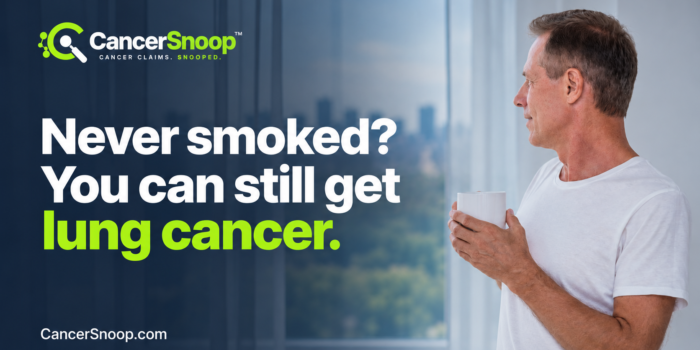
Never Smoked? You Can Still Get Lung Cancer
CancerSnoop · Health News Explained
Smoking is the biggest risk factor. It is not the only one.
Lung cancer can develop in people who have never smoked.
Understanding why means separating well-established risks
from findings that still need more research.
Can you get lung cancer without smoking?
Yes. Tobacco remains the leading risk factor, but it does not
explain every diagnosis.
[Reference 1]
[Reference 2]
The useful question is not whether someone “deserved” a diagnosis.
It is what the evidence can tell us about risk, what remains
uncertain and when to seek medical attention.
How Can Lung Cancer Develop Without Smoking?
Cancer develops when changes in cells allow them to grow
uncontrollably. Tobacco smoke is one way these changes can arise,
but environmental exposures and genetic susceptibility can also
play a role.
[Reference 1]
[Reference 2]
Understanding Risk
A risk factor is not a personal diagnosis.
Knowing that something increases risk does not tell us exactly
why one person developed cancer. An exposure is not a prediction,
and a diagnosis is not evidence of personal failure.
Which Risks Are Well Established?
Recognized risks beyond smoking include:
[Reference 1]
[Reference 2]
What Evidence Supports
Several exposures can affect lung cancer risk.
-
Radon: a naturally occurring gas that can
accumulate inside buildings. -
Secondhand smoke: breathing tobacco smoke
from other people. -
Air pollution: including harmful particles
in outdoor and household air. -
Workplace hazards: such as asbestos,
silica and diesel exhaust.
Family history and inherited susceptibility can also matter.
However, a genetic change found in a tumor is not automatically
something inherited from a parent.
[Reference 1]
What About Ultra-Processed Foods?
A 2025 study in Thorax followed 101,732 adults for an
average of 12.2 years. Researchers recorded 1,706 lung cancer cases.
People reporting the highest intake of ultra-processed foods had
a higher adjusted rate of lung cancer than those reporting the
lowest intake.
[Reference 3]
The reported hazard ratio was 1.41, often described as a 41%
relative increase. It does not mean that 41 out of
every 100 people developed lung cancer.
[Reference 3]
Evidence Gap
A link is not proof of a cause.
This was an observational analysis, not a randomized food trial.
Diet was self-reported. Researchers adjusted for smoking status,
but not smoking intensity, leaving room for remaining differences
between groups to affect the results.
Participants were not exclusively people who had never smoked.
The study cannot establish ultra-processed foods as a proven
cause of lung cancer in that group.
[Reference 3]
Why the Difference Matters
Established Risk
Evidence supports a causal role.
Radon, secondhand smoke and certain environmental or workplace
exposures are recognized lung cancer risks.
[Reference 2]
An Association Under Investigation
More research is needed.
The food study raises questions worth investigating. It does
not place diet on the same evidential footing as established
causes.
[Reference 3]
What Can People Do Practically?
Risk reduction is about sensible steps, not trying to control
every part of life.
Practical Steps
- Keep homes and shared indoor spaces smoke-free.
-
Consider home radon testing according to local guidance;
radon cannot be detected by smell. -
Use appropriate workplace protections against hazardous
dusts and fumes. -
Check local air-quality information and reduce exposure
when pollution is high. -
Tell your clinician about relevant exposures and a close
family history of lung cancer.
These measures can reduce exposure. They cannot guarantee that
cancer will never develop.
[Reference 1]
[Reference 2]
Symptoms Deserve Attention, Whatever Your Smoking History
A persistent cough, unexplained breathlessness, chest pain or
coughing up blood should be medically assessed. These symptoms
can have causes other than cancer, but never having smoked is
not a reason to dismiss them.
[Reference 1]
[Reference 2]
Avoid a Misleading Shortcut
“I never smoked” does not rule out lung cancer.
Assessment of symptoms and screening of people without symptoms
are different decisions. This article is not a recommendation
for everyone to arrange a CT scan.
Key Takeaways
- People who have never smoked can develop lung cancer.
- Smoking remains the leading risk factor.
- Environmental exposures and genetic susceptibility also matter.
-
The ultra-processed food study found an association,
not proof of causation. - Symptoms deserve attention without assumptions or blame.
Read More on CancerSnoop
CancerSnoop Bottom Line
Lung cancer is not defined by someone’s smoking history.
Clear information should help people recognize risks and seek
care. It should never turn an uncertain finding into a proven
cause—or a diagnosis into a judgment about someone’s life.
Sources and Evidence
1. Can You Get Lung Cancer Without Smoking?
American Cancer Society. Written by ASCO, with medical and
editorial review by the American Cancer Society content team.
Published November 12, 2025.
Expert patient guidance.
2. Lung Cancer
World Health Organization. Fact sheet dated April 16, 2026.
Institutional guidance on risk, prevention and symptoms.
3. Association between ultra-processed food consumption
and lung cancer risk: a population-based cohort study
Wang K, Zhao J, Yang D, Sun M, Zhou W, Wu Y.
Thorax. 2025;80(11):810–818.
First published online July 29, 2025.
Observational study. PMID: 40730472.
DOI: 10.1136/thorax-2024-222100
CancerSnoop Note:
Evidence and source information checked October 25, 2026.
This independent educational article does not diagnose symptoms
or replace individual medical advice.
Evidence and source information checked October 25, 2026.
This independent educational article does not diagnose symptoms
or replace individual medical advice.
Continue Exploring