Hair loss is not inevitable with chemotherapy. Your treatment drugs and doses affect the risk. This guide explains what to expect and what to ask your care team.
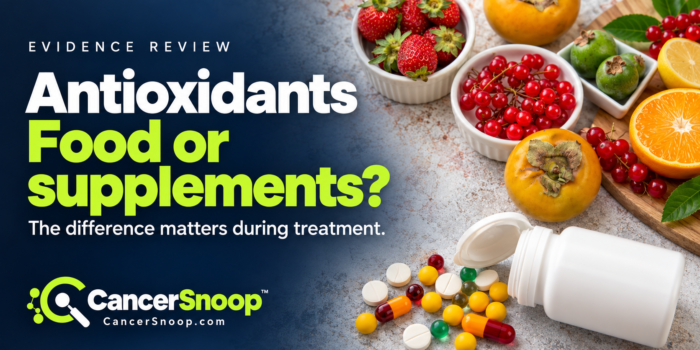
Antioxidant Supplements During Cancer Treatment: Helpful or Harmful?
CancerSnoop · Evidence Review
An antioxidant-rich meal and a high-dose supplement are different decisions.
Wanting to support your body during treatment is understandable.
The useful question is what helps—and what needs a safety check.
Antioxidant supplements during cancer treatment
deserve individual assessment. Evidence does not support assuming
that every product is beneficial, harmless or harmful.
The substance, dose and cancer treatment matter.
[Reference 2]
What Are Antioxidants?
Antioxidants help limit damage from unstable molecules called free
radicals. Examples include vitamins C and E. They occur in foods
and are also sold in concentrated products.
[Reference 2]
Does This Mean You Should Avoid Fruit and Vegetables?
No. The American Cancer Society recommends obtaining antioxidants
from foods such as fruits and vegetables. Its caution about
supplements is not a recommendation to remove these foods
from ordinary meals.
[Reference 3]
Food Sources
Nutrition remains important.
Foods supply nutrients and energy needed during treatment.
Eating difficulties may require a tailored nutrition plan.
[Reference 3]
Concentrated Supplements
The product needs its own assessment.
A “natural” or “antioxidant” label does not answer whether
a particular dose fits your treatment.
Why Could Supplements Interfere With Treatment?
Some anticancer treatments use reactive molecules to damage cancer
cells. Researchers therefore ask whether antioxidants could protect
healthy tissues while also interfering with cancer control.
A plausible mechanism alone cannot tell us what happens in patients.
[Reference 2]
What Does the Recent Research Show?
A 2025 systematic review examined antioxidant interventions during
radiotherapy. It included 39 randomized trials with 3,402 enrolled
patients, covering different cancers and preparations.
Some interventions improved particular side effects. However,
results were inconsistent, and concerns remained about tumour
control and survival. The authors did not support routine
recommendations based on this evidence.
[Reference 1]
An Important Limitation
A systematic review is only as reliable as its underlying studies.
Twenty-three trials had a high risk of bias, ten had some concerns
and six had a low risk. Different substances and topical or systemic
preparations cannot be treated as interchangeable.
[Reference 1]
Fewer Side Effects Do Not Answer Every Safety Question
A preparation might improve mouth soreness or another symptom
without establishing that it preserves long-term cancer control.
Both outcomes need investigation.
[Reference 1]
NCI’s evidence summary also describes concerning findings in
particular chemotherapy and radiotherapy settings. Some findings
are observational, and laboratory results should not be presented
as proven harm in people.
[Reference 2]
Read the Evidence Carefully
“May help a symptom” does not mean “safe with every treatment.”
Ask which product was studied, how it was given, and whether
the study measured cancer outcomes as well as symptoms.
Can Supplements Ever Be Appropriate?
Yes. Poor intake or a nutritional problem may justify supplementation
after assessment. The American Cancer Society advises discussing
vitamins and minerals with the care team rather than independently
choosing large doses.
[Reference 3]
A Practical Safety Step
Review the actual label before making changes.
Bring the bottle or a clear photograph to your oncologist,
pharmacist or oncology dietitian. Include the ingredients,
dose and how often you take it.
Do not stop prescribed supplementation solely because you
encounter a general warning online.
Questions to Ask About Antioxidant Supplements During Cancer Treatment
- What specific benefit are we trying to achieve?
- Is there a documented nutritional need?
- Has this product been studied with my treatment?
- What dose and duration would be appropriate?
- Do the studies assess cancer control or only side effects?
- Could food or established supportive care meet the same need?
Key Takeaways
- Food and concentrated supplements require different decisions.
- Evidence varies between products and treatment settings.
- Symptom improvement does not establish long-term safety.
- A supplement review should use the actual ingredients and dose.
Related CancerSnoop Articles
CancerSnoop Bottom Line
CancerSnoop Bottom Line
Support your nutrition. Check the supplement.
You deserve a clear explanation of what a product is expected
to do, what evidence supports it and how its safety will be assessed.
Bring those questions to your care team.
References and Trusted Sources
Reference 1 — The influence of antioxidant supplementation on
adverse effects and tumor interaction during radiotherapy:
a systematic review
Limbrunner J, Doerfler J, Pietschmann K, Buentzel J,
Scharpenberg M, Huebner J.
Clinical and Experimental Medicine.
2025;25:258. Published July 22, 2025.
DOI: 10.1007/s10238-025-01804-x · PMID: 40691411
Reference 2 — Cancer Therapy Interactions With Foods and
Dietary Supplements (PDQ®)–Health Professional Version
National Cancer Institute.
PDQ Integrative, Alternative, and Complementary Therapies Editorial Board.
Last updated April 5, 2024. PMID: 33079503.
Reference 3 — Benefits of Good Nutrition During Cancer Treatment
American Cancer Society.
Patient guidance. Last revised October 13, 2025.
Evidence and source check: October 27, 2026.
This article provides educational information and does not replace
individual advice from your cancer care team.
This article provides educational information and does not replace
individual advice from your cancer care team.
Continue Exploring